Save a Tree
 Every
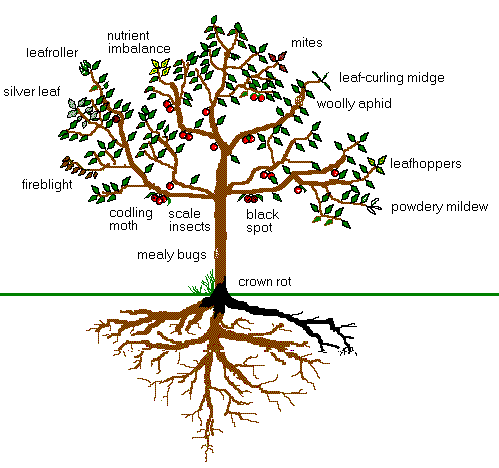
so often you will notice a tree/bush/shrub hurting. In Florida, palms in
particular can show yellowing. Disease, bugs, excess cold can stress a
tree and you can lose it. The healthier a tree the better chance that you can pull it
through a period of stress.
Every
so often you will notice a tree/bush/shrub hurting. In Florida, palms in
particular can show yellowing. Disease, bugs, excess cold can stress a
tree and you can lose it. The healthier a tree the better chance that you can pull it
through a period of stress.
In fact as a fruit grower and landscape contractor in upstate New York where we
made our living there were various problems that surfaced. White Birch under
stress from a bug called leaf minor was a problem if the tree was neglected and
the owner did not use the different systemic applications that did the job of
protecting the plant.
What can you do?
The first thing that a plant owner will think about is fertilization. Feeding a
stressed plant could save it, if it is done right. In fact if you want to do it
up right you certainly can apply it to all of your trees or at least some of
them on a maintenance basis. In another words you can apply this process on
healthy trees as I do every year or at least on your specimens, as this involves
a little effort.
As far as the type of fertilizer, I
have luck with Home Depots Vigoro brand, the 10-10-10 or something close to it.
When you pick up the bag make sure there are not any breaks in the bag.
Keeping a bag of fertilizer sealed is important as an open bag that has picked
up moisture has little nutritional value.
Below are two procedures to save a tree/bush/plant when in
stress.
Fertilization on trees can be effective and in some cases if the feed is just
applied on top of the ground there is a good chance that before the material
reaches the root zone the pop of the material has been dissipated into the air.
Now in the case of small plants in the garden
where the roots are close to the top of the ground it is important to cultivate the
feed material and work it lightly into the soil. In the case of trees it isn't as easy
especially if it is a tree where the roots have spread out and encompasses a large
area and an area that is not cultivated.
In fact most of the northern tree
species have a characteristic where the majority of the feeder roots are under
the drip edge of the trees. When we fed fruit trees we applied feed in a narrow
band about 30 inches wide and again under the drip edge.
In the case of the two images below material was applied very close to the trunk
as they are palm trees and palm tree roots do not spread out but very little
from the trunk. We would strongly suggest that you try to determine the tree you
are working with and contact the government agricultural extension service and
find out what the root spread is.

Step 1.
In the images above and below you will clearly see the white granular fertilizer
that was applied on the ground.
Step 2.
A bar is then taken and holes are punched around the tree and in this
case we are working with palms. If you were working with a tree where the major
feeder roots were out 10, 15 and even as much as 20 feet at the drip edge you
would punch a band of holes around this area in the neighborhood of 24 to 30
inches wide. In this process you are driving a certain amount of feed into the
ground with the bar. (Step 3 below image)

Step 3 (The fun part)
I say fun part because when you get done punching holes with a bar around any
tree you will appreciate the break by getting the hose out and washing the
balance or a least most of it down into the holes. Don't blast the ground with
the hose. Do it gently and try to get as much of the fertilizer that
hasn't been punched down into the holes
with the light application, along with what you drove in with the bar to begin
with.
In a day or two after the ground dries in the areas that are kept cultivated,
hook the ground up and in the process close up the holes that were not closed
during the hosing process.

Peacedale Farm History
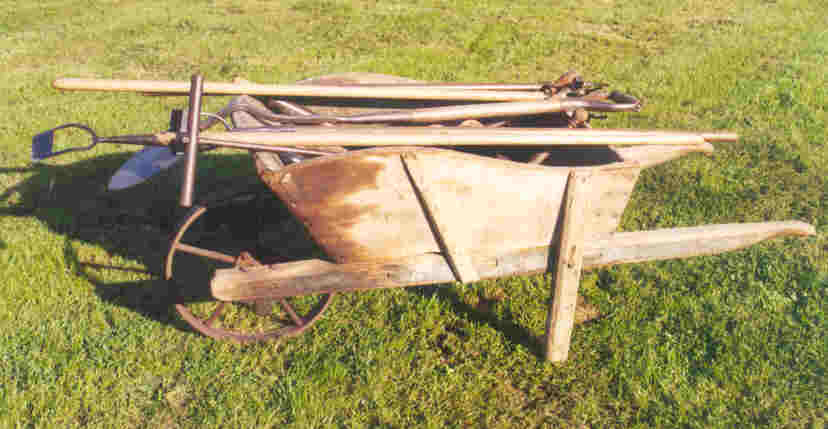
Take note of the special cultivating tool on your right that we used on our 30
acres of Strawberry cultivating practices. It is a special tool and if you bring
up our http://www.blueeyedcurse.com/gardeningmyway.htm feature you will be
intrigued with the 300 year history of this tool along with a lot of gardening
points.
For areas where the band was not cultivated
and in sod take a good sharp shovel and go
around the band and sod in a chopping fashion and try to seal the ground as best
you can. In fact just the chopping alone will pay dividends in regard to osmosis
and what they call capillary action that takes place when ground is loosened up
from a compacted state.
Capillary Action
 Plants and trees couldn't thrive without capillary action. Plants put down roots
into the soil which are capable of carrying water from the soil up into the
plant. Water, which contains dissolved nutrients, gets inside the roots and
starts climbing up the plant tissue. As water molecule #1 starts climbing, it
pulls along water molecule #2, which, of course, is dragging water molecule #3,
and so on.
Plants and trees couldn't thrive without capillary action. Plants put down roots
into the soil which are capable of carrying water from the soil up into the
plant. Water, which contains dissolved nutrients, gets inside the roots and
starts climbing up the plant tissue. As water molecule #1 starts climbing, it
pulls along water molecule #2, which, of course, is dragging water molecule #3,
and so on.
A little more 300 year Peacedale History
below